

· AFX Research, LLC
What the County Recorder Does Not Hold, and Who Holds It
A filing office archives what people bring it and checks almost nothing. What that means for a search, which obligations live elsewhere, and how to read a clean result.
Table of Contents
Ask what a county recorder does and the honest answer is narrower than most people expect. It accepts documents, checks that they are formally in order, and files them where they can be found again. It does not verify them, and it does not go looking for anything. Understanding that one fact explains most of the limits of a title search, and it follows directly from what a title search is not.
The office is an archive, not an investigator
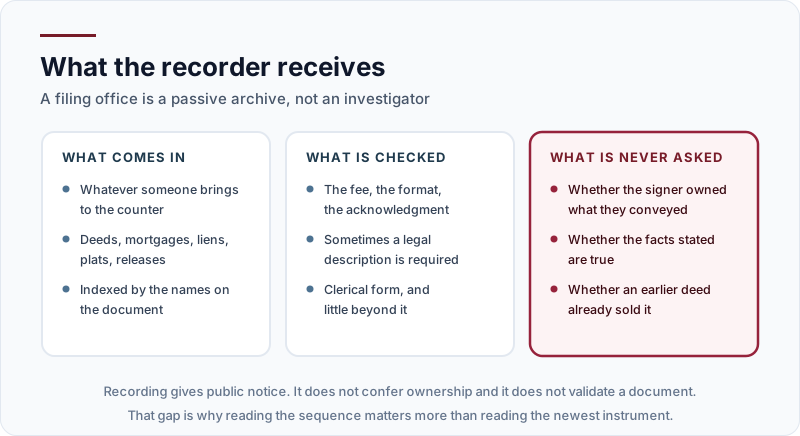
What arrives is whatever somebody carries to the counter. Deeds, mortgages, liens, plats, releases, indexed under the names printed on the document.
What gets checked is clerical. The fee, the format, the acknowledgment, sometimes a legal description. Whether the page is legible enough to scan.
What is never asked is the interesting part. Nobody at the counter asks whether the signer owned what they purported to convey, whether the facts stated in the document are true, or whether an earlier deed already sold the same land to somebody else. Recording gives public notice. It does not confer ownership and it does not validate the instrument, which is precisely why reading the whole sequence beats reading the newest document in it.
Real obligations, kept somewhere else
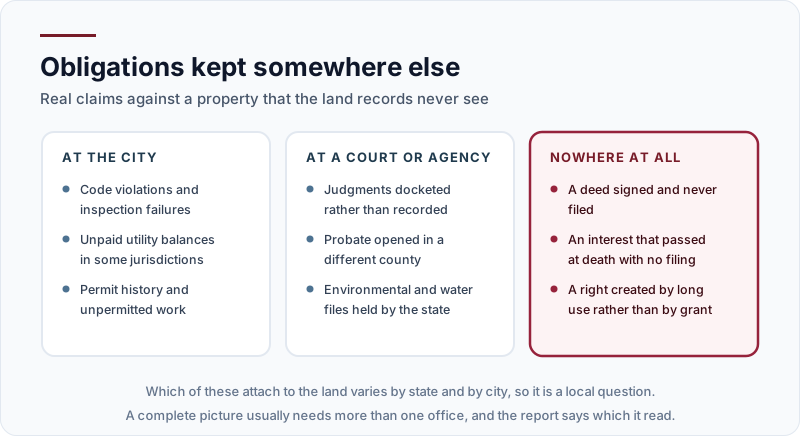
At the city. Code violations, failed inspections, permit history, and in some jurisdictions unpaid utility balances that attach to the parcel rather than to the occupant. Whether they attach at all varies by state and by city, so it is a local question every time.
At a court or an agency. Judgments are frequently docketed at a court rather than recorded at the recorder. Probate may have been opened where the deceased lived rather than where the land sits. Environmental files and water rights are held by state agencies that have no connection to the county index.
Nowhere at all. A deed signed and never filed. An interest that passed at death with nothing recorded locally. A right created by decades of use rather than by any grant. These are genuine interests that a records search structurally cannot return, because there is no record of them to find.
There is a fourth category that catches people out because it sounds like the recorder’s business and is not. Anything about where a boundary physically runs, whether a structure sits inside it, or how a described easement lines up with the track on the ground belongs to a surveyor. The recorder holds a description of the land, written in words, and words and dirt are related only loosely once a few decades have passed.
Reading the boundary honestly
It is worth being clear that none of this is a criticism of the office. A recorder that refused documents it doubted, or that adjudicated competing claims at the counter, would be a court rather than an archive, and the system depends on it being neither. The passivity is the design. It is what makes the record cheap to add to, fast to search, and available to anyone who walks in.
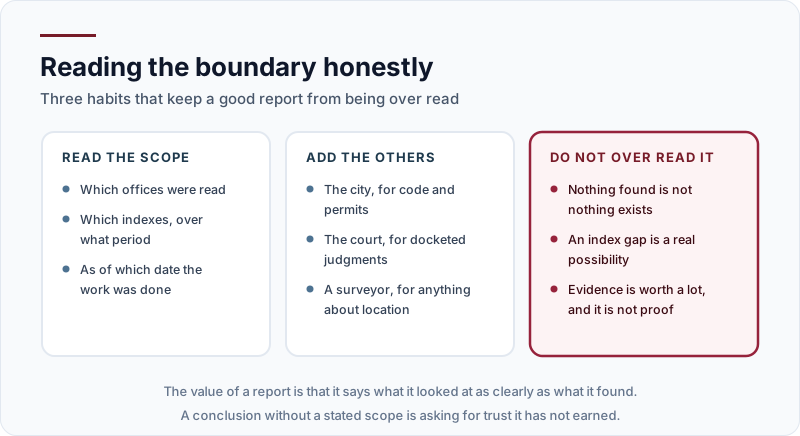
Three habits follow. Read the scope line first, which should say which offices were read, which indexes, over what period, and as of what date. Add the other sources the question actually needs, whether that is the city for permits, the court for judgments, or a surveyor for anything about location. And do not over read a clean result, because nothing found in the indexes read is a narrower statement than nothing exists.
None of this makes the record less useful. It makes it a defined instrument rather than an oracle, and a report that states its own boundary is worth considerably more than one that quietly implies it has none. That is the same principle at work in why recording practice is local, where the variation between counties decides what an index could even contain.
The takeaway
The recorder holds what was brought to it and vouches for none of it, and several categories of real obligation live in offices that have nothing to do with land records. Read the scope, gather the other sources your question needs, and treat a clean report as strong evidence rather than as proof. Find the property that runs your search, or tell us what you are trying to establish and we will point you at the right one before anything is ordered.