

· AFX Research, LLC
What Happens When the Public Land Record Is Simply Wrong
The three ways a land record fails, why a misindexed instrument is the dangerous one, who ends up carrying it, and the routes available for fixing it.
Table of Contents
The public record is treated, reasonably, as the authoritative account of who owns what. It usually is. But it is assembled by people from documents drafted by other people, and at the scale of a county courthouse over a century and a half, some fraction of it is wrong. Understanding how it goes wrong is more useful than assuming it does not, because the three failure modes behave very differently and only one of them is genuinely dangerous.
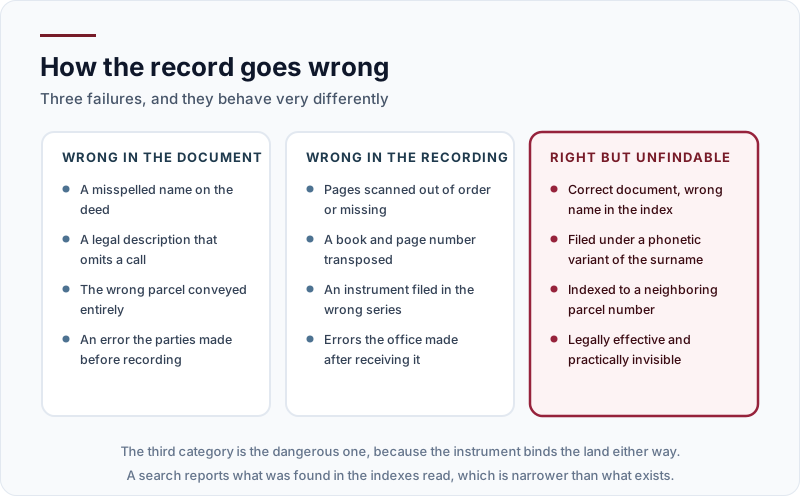
Three ways it fails
The first is an error inside the document. A misspelled name, a legal description missing a call, occasionally the wrong parcel conveyed entirely. These arrive at the recorder already wrong, and the office records them faithfully.
The second is an error the office made. Pages scanned out of order, a transposed book and page number, an instrument filed into the wrong series. The document was fine when it arrived.
The third is the one worth worrying about. The instrument is correct, it was recorded properly, and the index entry points somewhere else — a surname filed under a phonetic variant, a parcel number off by a digit. The document is legally effective and practically invisible.
Why misindexing is the dangerous one
A searcher reads indexes. Nobody pages through every volume in a county, which means an instrument the index will not surface is an instrument the search does not find, and a clean report gets issued in complete good faith. This is one of the reasons why two searches can return different answers even when both were done competently.
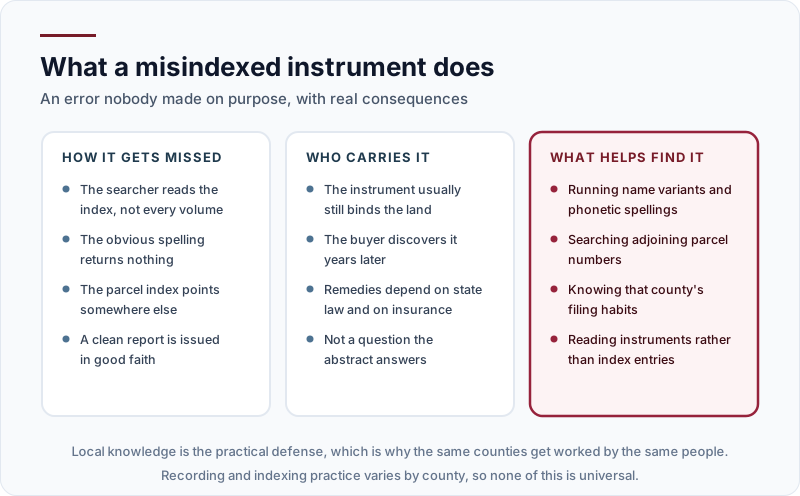
The consequence lands on whoever bought the property. The instrument generally still binds the land, whatever the index says about it, and the defect surfaces years later when somebody else searches more thoroughly or from a different angle. What remedies exist depends on state law and on whether a policy was bought, which is not a question an abstract answers.
What reduces the risk is method rather than technology. Running name variants and phonetic spellings, searching adjoining parcel numbers, reading the instruments rather than the index summaries, and knowing the filing habits of that particular county. Local knowledge is the real defense here, which follows from why recording practice is local.
Fixing it
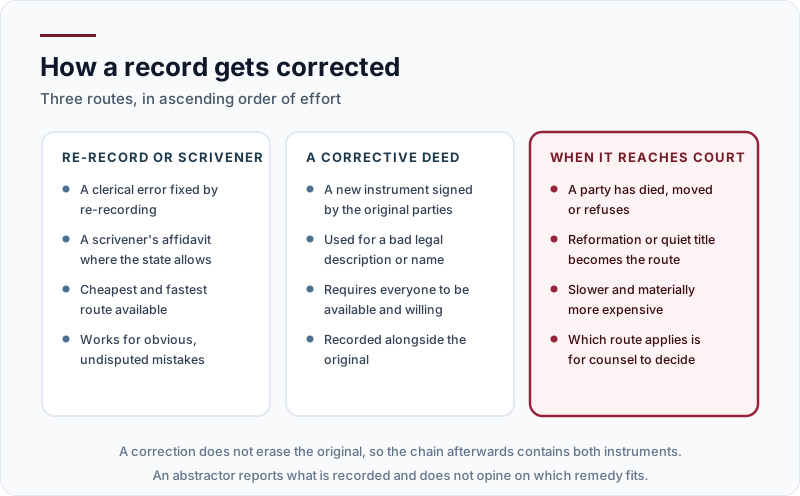
There are three routes and they escalate in cost. An obvious clerical slip can sometimes be handled by re-recording, or by a scrivener’s affidavit where the state permits one. A substantive problem such as a bad legal description usually needs a corrective deed, a new instrument signed by the original parties and recorded alongside the first, which works only while everyone is available and willing.
When they are not, because someone has died, moved, or simply refuses, it becomes a court matter. Reformation or a quiet title action will resolve it, and both are slower and considerably more expensive than the alternatives. Which route applies is a legal question for counsel in that state.
One thing worth knowing is that a correction does not erase anything. The original stays in the record, and the chain afterwards contains both instruments, which is why a later searcher needs to read them together rather than assume the newer one supersedes the older.
What this means for reading a report
It argues for reading the scope line first. A report that states what it searched can be compared, reconciled, and extended. A report that states a conclusion and nothing about its method cannot be checked against anything, which is the point made in what a title search is not.
It also argues against treating an empty result as proof. A clean report means nothing was found in the indexes read over the term searched, as of the date of the work.
The takeaway
The record is reliable enough to build a property system on and not so reliable that an empty result settles anything. Errors in documents get corrected, errors by the office get noticed, and errors in the index quietly do not. Ask what was searched and how. Find the property that runs your search, or tell us what you are trying to establish and we will point you at the right one before anything is ordered.